Public Health - Laboratory Costing Tool
The Public Health Laboratory Costing Tool is designed to help estimate the cost of standing up labs in developing countries. These labs need to be equipped and staffed to help detect, assess, and respond to public health matters of national and international concern.

Developing countries often have difficulty estimating the costs of implementing laboratory services at the community, district, regional, and national levels.
This tool is designed to help estimate the costs, so that international funders have a reasonable estimate of how much is needed to implement and sustain laboratory capability in developing countries.
I've served as the primary design and development consultant on this project in concert with the GW School of Public Health. We've conducted multiple brainstorming sessions with Subject Matter Experts, come up with a workflow and a data model, and begun development of the tool
This is our first attempt at a tool, currently at the development stage using a jQuery / PHP / MySQL technical stack.
Research
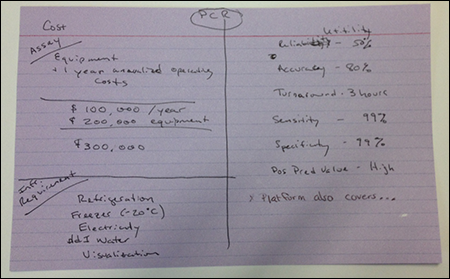
The initial research phase involved talking through the inputs and outputs of the tool, defining what the tool needs to measure, and giving example values.
These values were then used in the next phase, to define how the inputs and outpus of the system will work.
Analysis
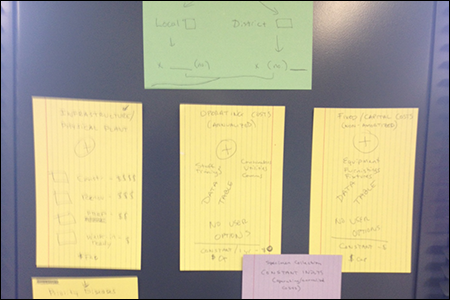
The analysis phase set up the workflow of the system for the initial tool, which focuses on laboratory capability at the local and district levels. We started to determine the flow of information and user choices throughout the application, defining variables along the way.
At this juncture, we also created a data model that defined standard values (a basic set of infrastructure, materials, and staff) followed by variables (consumables and additional elements) that could be added via user selection.
Prototyping
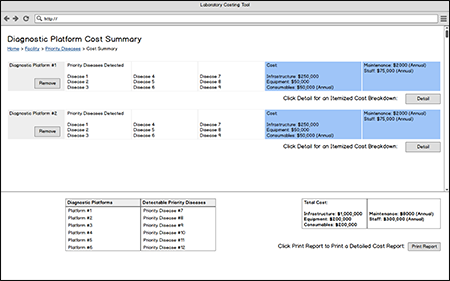
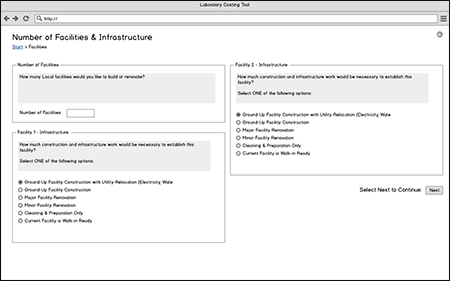
The prototyping phase involved creating UI sketches using balsamiq mockups, focusing on plain-language chocies for the end user and automatically populated costs. These auto-populated costs represent a first estimate for end users, and are later customizable if a particular country or individual has more accurate information.
NEXT STEPS...
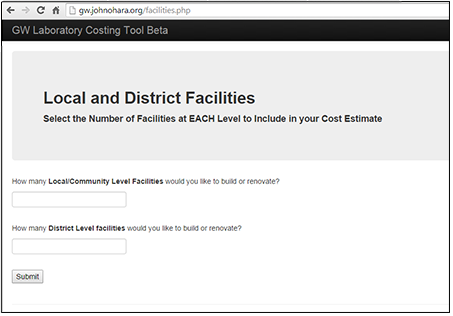
Starting Development
I've begun the process of coding this tool as a web-based application using html/css/jquery and PHP/MySQL. A beta version is currently in development for review by the end of October 2014.

